
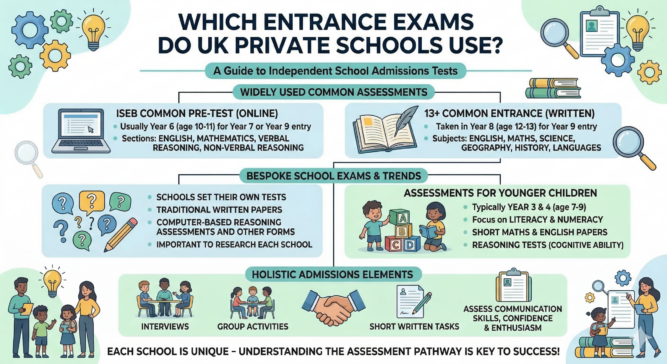



It may surprise parents, particularly those located overseas, to know that the UK independent school sector does not solely rely on a single national admissions test. It is instead the case that schools will use different assessments depending on the level of selectivity of the school. It is therefore really useful for parents to understand the main options within this test system, in order to navigate the process more easily.
There are a few different exams which are common to multiple schools, and we’ll start with these. Firstly, one of the most widely used assessments is the ISEB Common Pre-Test. This is an online test and it is usually taken in Year 6 by children who want to apply to senior schools for either Year 7 or Year 9 entry. There is also a test designed to be taken in Year 5 for Year 6 entry. The test consists of English, mathematics, verbal reasoning and non-verbal reasoning sections.
Learn more about School Entrance Score AssessmentsSecondly, if a child is applying to Year 9 for 13+ entry, another common pathway is the Common Entrance Examination. This is a test which has evolved over the years; it is not used by every school but is quite common in prep schools which finish at Year 8. Common Entrance covers subjects including English, mathematics, science, geography, history and languages. It is take by children in preparatory schools to assess whether they are ready to move on to their chosen senior school and then used by senior schools for setting purposes.
Moving on, there is a rising trend for some independent schools to set their own bespoke entrance exams. There are a wide variety of these and so it is important to get advice if you are planning for your child to sit a specific test. Sometimes they will include traditional written papers, and sometimes reasoning assessments which are often computer-based.
There are also some assessments for younger children. In Year 3 or Year 4, assessments tend to be simpler and more focused on literacy and numeracy skills. For example, it is quite common for children to complete short Maths and English papers and also take reasoning tests designed to measure future and current cognitive ability.
Purchase a CEM Test for your childFinally, schools recruiting children for all ages often include interviews, group activities and short written tasks alongside their more formal exams. This allows admissions teams to evaluate children’s qualities that tests alone cannot capture, such as communication skills, confidence and their personal enthusiasm for learning.
Because each school has its own approach, it is really important for families to research the specific requirements of the schools they are considering; if there is more than one, this process will definitely need some support. Admissions pages and open days often provide detailed guidance on the exact assessments used, but the help of a tutor can be invaluable. Although the variety of exams used by independent schools for entrance can seem complicated at first, it is true to say that they do all share a common goal: helping schools to identify those children who they think will thrive academically and socially within their school community.